

Organic semiconductor breakthrough could improve wearable healthcare sensors
Researchers have developed a new way to precisely control organic semiconductor performance, paving the way for more efficient wearable healthcare sensors and flexible medical electronics.
Researchers at Hanyang University in South Korea have developed a new method for controlling the performance of organic semiconductors, a breakthrough that could accelerate the development of wearable healthcare devices, self-powered sensors and other flexible electronic technologies.
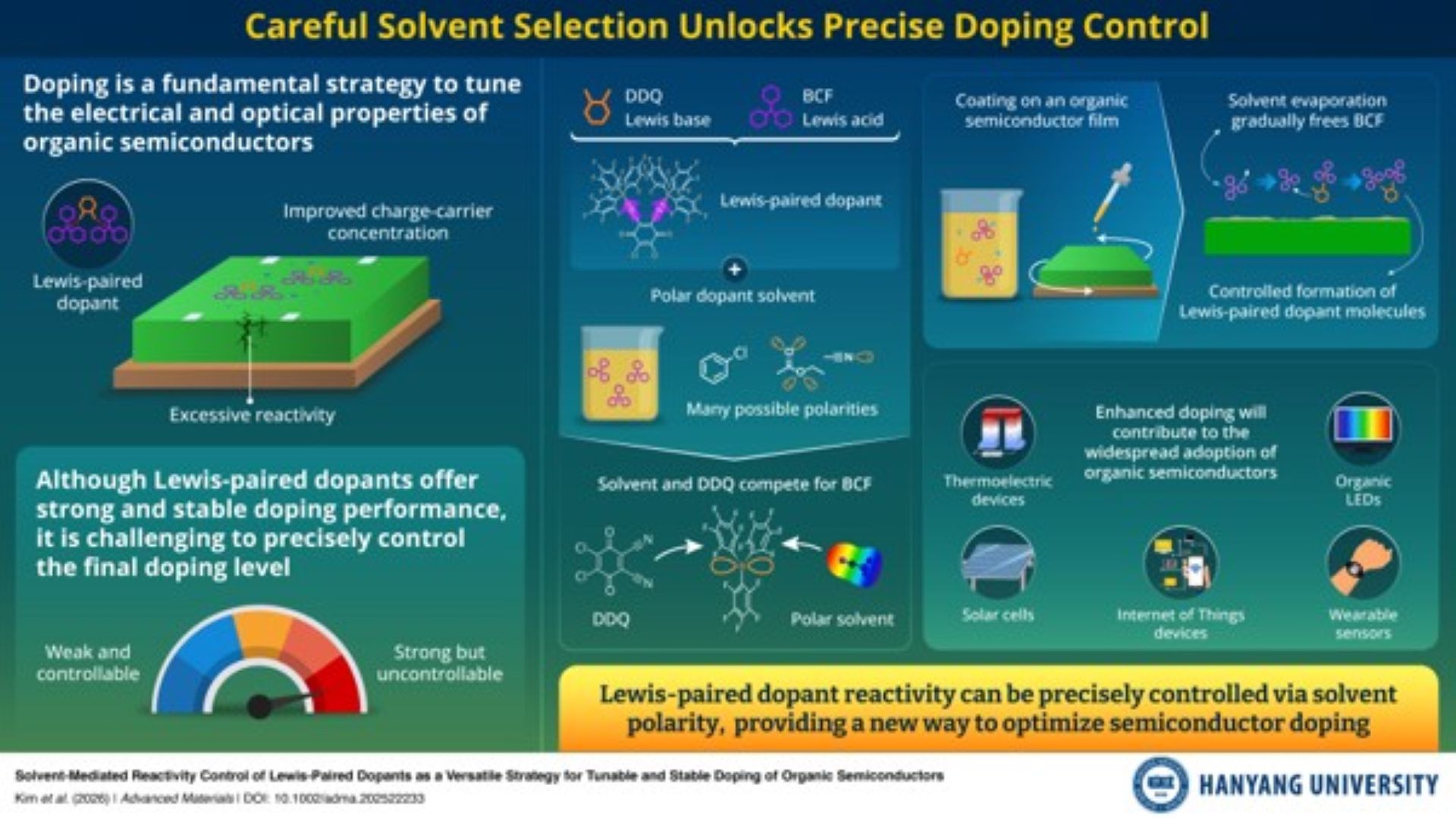
The study demonstrates how careful selection of processing solvents can precisely regulate semiconductor doping, a critical process that determines how efficiently these materials conduct electricity.
Organic semiconductors are increasingly being explored for use in lightweight, flexible electronics because they can be printed onto thin, bendable materials. Potential healthcare applications include wearable biosensors, continuous patient monitoring devices and self-powered medical sensors that harvest energy from body heat.
Achieving precise doping has long presented a challenge for researchers. While Lewis-paired dopants offer high stability and strong electrical performance, their highly reactive nature has made it difficult to accurately control doping levels without affecting the semiconductor itself.
The Hanyang University team developed a solvent-mediated approach that regulates the behaviour of Lewis-paired dopants during processing. Rather than altering the dopant chemistry, the researchers demonstrated that solvent polarity can be used to control how the dopants interact, allowing precise tuning of semiconductor performance.
Using ethyl acetate as the processing solvent, the researchers successfully achieved controllable doping across several different organic semiconductor materials, including materials previously considered difficult to optimise.
The resulting materials demonstrated high thermoelectric performance, suggesting they could efficiently convert heat into electricity. This capability could prove particularly valuable for wearable electronics that generate power from body heat, reducing reliance on conventional batteries.
Professor Jaeyoung Jang said: “Our simple solvent-mediated strategy provides a new way to optimize semiconductor doping without designing entirely new dopant molecules. This approach could pave the way to high-performance and stable organic thermoelectric materials for self-powered wearable devices and low-power sensors.”
Unlike conventional silicon electronics, organic semiconductors offer flexibility, lightweight construction and lower manufacturing costs, making them attractive for next-generation healthcare technologies. However, achieving the right balance of electrical performance and long-term stability has remained a significant obstacle to wider adoption.
The researchers believe their approach could extend beyond wearable electronics to support advances in organic solar cells, organic light-emitting diodes, Internet of Things devices and next-generation diagnostic technologies.
By simplifying the manufacturing process while improving material performance, the technique could also help accelerate commercial development of flexible electronic devices for healthcare and consumer applications.
Professor Jaeyoung Jang added: “We believe this concept will influence the design of future organic electronic materials and help accelerate the development of next-generation flexible and sustainable electronics.”
The findings were published in Advanced Materials.


