Personalised cancer medicine: closing the clinical trial access gap
Personalised cancer medicine is advancing, but better biomarker testing, clinical trial matching and patient access remain essential to delivering precision healthcare at scale, says Dr Neel Belani of START New Jersey.
Dr Neel Belani, Director of Clinical Research at START New Jersey, part of The START Center for Cancer Research’s global network of early-phase clinical trial sites, discusses the progress of precision oncology, the challenges of matching patients with clinical trials and the role of community-based research in making experimental treatments more accessible.
In this interview with Discover Pharma editor-in-chief Liza Laws, Dr Belani also explores how real-world data can improve understanding of cancer treatments, why patients need better access to molecular testing and what must change for personalised medicine to benefit more people.
How has personalised medicine in oncology changed over the past decade?
Over the past decade, researchers have developed a better understanding of the molecular changes that occur within tumours. These changes are not necessarily inherited genetic variants passed between generations. Instead, they can be acquired alterations in the genetic code of an individual tumour.
Identifying these changes can help clinicians determine whether a patient may benefit from a treatment designed to target a particular molecular mechanism.
However, many potential targets remain under investigation, with some still in the laboratory stage of development and others progressing through clinical trials.
Dr Belani believes the field is only beginning to realise the potential of this approach.
One important area of research is RAS, a family of proteins involved in regulating cell growth. Mutations affecting RAS signalling can contribute to cancer development, making the pathway an important target for drug discovery.
Dr Belani said: “Researchers have understood the importance of RAS signalling in cancer for decades, but directly targeting RAS proteins long seemed extraordinarily difficult. Recent advances in drug development are beginning to change that.”
The development of newer drugs is creating additional opportunities to target proteins involved in cancer growth.
For Dr Belani, this progress provides grounds for optimism, although many potential targets still require further research and clinical evaluation.
Access to clinical trials is an important part of this process. Through the START network, the research centre can offer patients opportunities to participate in studies investigating emerging treatments, including therapies directed at specific molecular alterations.
What does precision medicine at scale mean in practice?
Precision medicine at scale means making personalised approaches to diagnosis and treatment available to more patients, rather than restricting them to a relatively small group who undergo molecular testing or attend specialist centres.
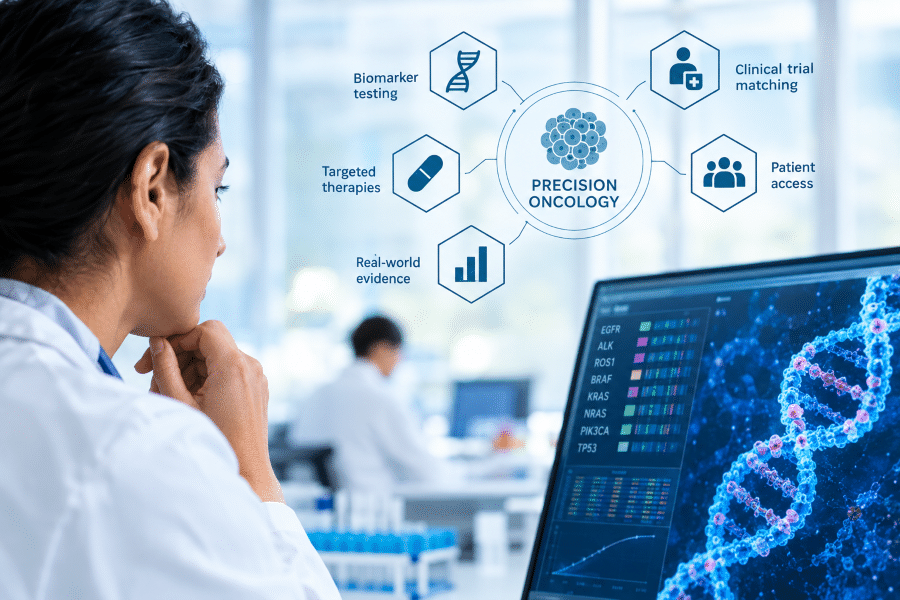
Biomarker testing is central to this objective. By identifying particular genetic alterations or other biological characteristics, testing can help clinicians determine which treatments may be appropriate for an individual patient.
Dr Belani believes greater awareness among patients and advocacy organisations is helping to encourage conversations about molecular testing.
Patients are increasingly seeking information about their tumour biology and asking whether testing could influence their treatment options. For precision oncology to become more widely available, this interest must be matched by appropriate testing and access to therapies.
Lung cancer illustrates why this matters.
Historically, treatment decisions were made largely according to broad tumour classifications. Advances in molecular testing have revealed further distinctions within these groups, with different genetic alterations potentially requiring different treatment approaches.
Dr Belani explained that tumours that appear similar under a microscope may have different molecular characteristics and respond differently to treatment.
Without genetic testing, clinicians may not have the information needed to select the most appropriate targeted treatment.
However, testing alone cannot deliver the full promise of personalised medicine. Researchers must also develop effective therapies for the molecular changes they identify.
How could precision oncology change clinical trial recruitment?
As cancer treatment becomes more personalised, clinical trial recruitment must also adapt.
Traditional approaches often depend on clinicians knowing which studies are open and identifying suitable patients. However, the growing number of trials, molecular targets and eligibility criteria makes it increasingly difficult to maintain a complete picture of available opportunities.
Molecular testing reports sometimes include lists of clinical trials that may be relevant to a patient’s diagnosis. However, these lists can quickly become outdated as recruitment status, eligibility criteria and trial locations change.
Dr Belani believes patients need more accessible ways to identify studies that could be appropriate for them.
Ideally, a patient would be able to provide information about their tumour’s molecular profile and clinical circumstances and receive guidance towards potentially relevant trials.
Platforms designed to improve trial matching are being developed, but the challenge is to ensure that the information reflects the changing availability of studies and accounts for individual eligibility requirements.
Dr Belani described his role in this process as that of a matchmaker.
His task is to identify studies that may be suitable for a patient, taking account of factors such as tumour type, molecular profile and the practical requirements of participation.
Better matching could help connect patients with trials they might otherwise never discover. It could also help researchers identify eligible participants more efficiently.
However, a potential match does not guarantee that a patient will qualify for a study or that the investigational treatment will be effective. Clinical assessment remains essential.
What makes community-based cancer research different?
START New Jersey combines community-based oncology care with a research model focused on access to early-stage clinical trials.
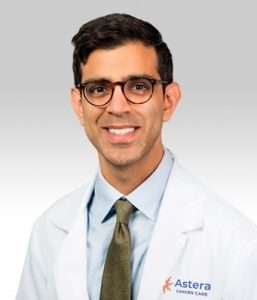
Dr Belani described START New Jersey as a partnership with Astera Cancer Care, a community-based oncology practice with approximately 35 medical oncologists, alongside urologists, breast surgeons and radiation oncologists across around 14 locations in New Jersey.
The approach brings together an established community oncology network and START’s experience in Phase 1 research.
Its geographical position between New York City and Philadelphia also provides access to a substantial patient population. New Jersey itself has approximately 10 million residents, according to the estimate discussed during the interview.
For patients, proximity can make a meaningful difference.
Travelling to a major academic medical centre may involve long journeys, complicated arrangements and additional physical demands. These challenges can be particularly difficult for people who are already unwell or undergoing intensive cancer treatment.
Community-based oncology practices can do more than refer patients to distant research institutions: with appropriate infrastructure and oversight, they can participate directly in high-quality early-phase research while maintaining links with the patient’s wider care team.
Dr Belani also highlighted the potential advantage of START being able to open studies more quickly than some larger institutions. START’s relationships with biotechnology companies help bring additional clinical trial opportunities into its research portfolio.
As a result, patients may be able to access studies locally that are not available at a nearby academic centre.
Dr Belani said the team also aims to make the initial process straightforward by communicating clearly about which trials are available, whether a patient may be eligible and what needs to happen next.
This approach recognises that time matters to patients, particularly when they are making decisions about treatment options during a serious illness.
How can patient data lead to better treatment decisions?
Oncology generates substantial amounts of information, from genomic test results and electronic health records to data collected during clinical trials and routine clinical practice.
The challenge is to turn that information into evidence that improves treatment decisions.
Dr Belani noted that patients increasingly use artificial intelligence tools to help interpret molecular test results and explore possible treatment and trial options.
Some patients, for example, are already entering their reports into ChatGPT to explore potential treatment approaches.
He views this as an opportunity to support more informed conversations with clinicians, while emphasising that trial matching involves far more than a molecular alteration.
A possible trial match must be checked against prior treatments, performance status, organ function, study-specific eligibility, location and current recruitment or slot availability. AI-generated suggestions cannot replace specialist clinical assessment.
Dr Belani also stressed the importance of ensuring that the information collected during clinical trials serves a clear purpose.
Whether patients are asked to provide blood samples, complete questionnaires or undergo additional assessments, researchers should understand how the information will contribute to the study.
Collecting more data is only beneficial if it helps answer meaningful questions.
This is particularly relevant when considering real-world data, which can provide insight into how treatments perform outside the carefully selected populations enrolled in clinical trials.
Why is real-world evidence important in oncology?
Clinical trials are essential for assessing the safety and effectiveness of investigational medicines. However, the patients who participate may differ from those who receive the treatment after approval.
Trial eligibility criteria can exclude people with certain medical conditions, reduced organ function or poorer physical health. Patients must also be able to attend appointments, undergo monitoring and meet the practical requirements of participation.
Consequently, clinical trial results may not fully reflect the experiences of everyone who could eventually receive a medicine.
Dr Belani highlighted the limitations of relying exclusively on trial populations to understand how treatments perform in routine practice.
For example, some patients with advanced cancer spend more than half of the day in bed because of their symptoms or declining health. They may be less likely to qualify for clinical trials, even though their clinicians still need to make treatment decisions.
Real-world evidence can help researchers and clinicians investigate how approved medicines perform in broader patient populations, including people who were not eligible for the original trials.
It can also provide additional information about treatment safety in routine care.
Dr Belani said this evidence is important for understanding medicines in their wider clinical context.
Real-world data does not replace randomised clinical trials, and observational findings can be affected by differences between patient groups and other sources of bias. However, used appropriately alongside clinical trial results, it can help build a more complete picture of treatment outcomes.
 What are the biggest barriers to clinical trial access?
Finding an appropriate clinical trial can be difficult for patients and their families, particularly when time is limited and treatment options are narrowing.
The interview highlighted a central problem: suitable studies may be available, but patients may struggle to identify them.
A key challenge is improving the way patients are connected with trials that match their tumour type, biomarkers and individual circumstances.
ClinicalTrials.gov provides a major source of information about registered studies, but Dr Belani believes patients could benefit from more accessible tools that help them identify relevant opportunities and determine where trials are recruiting. He also highlighted Hope Hub, an online platform that helps people to search for active studies at START locations in the United States and internationally.
The aim is to make it easier to search for trials using information such as biomarkers and tumour type, helping patients identify centres that may offer relevant studies.
However, finding a study is only one part of the access problem.
Patients may need to travel to a research centre, attend imaging appointments, undergo blood tests and coordinate care with other clinicians. Transport costs, work commitments, physical limitations and the availability of support from family members can all influence whether participation is feasible.
These barriers can disproportionately affect people with fewer financial resources or limited access to transport and specialist services.
Dr Belani also highlighted how social determinants of health can influence whether patients find and participate in clinical trials.
Improving access therefore requires more than making trial information available online. It also means considering where studies take place, how patients are referred and what practical support they need to participate.
For patients and families who have exhausted standard treatment options, these challenges can be particularly distressing.
Liza Laws shared her own experience of searching for a clinical trial for her brother, who had grade 4 glioblastoma and died nine months after diagnosis.
In response, Dr Belani acknowledged that improving access and matching patients to appropriate studies remains a significant challenge.
He said: “I think there’s a huge opportunity here to better match people to trials. For people to have a place they can go to that can steer them towards a site that has trials and has an opportunity for them.”
How can clinical trials become more representative?
Ensuring that clinical trials reflect the populations affected by cancer remains an important challenge.
Patients’ opportunities to participate can be shaped by geography, socioeconomic circumstances, access to healthcare and the practical demands of attending research appointments.
Dr Belani highlighted the difficulties patients may face when they need transport to a trial site, regular imaging or laboratory tests, or additional appointments with members of their existing care team.
Community-based research can reduce travel burdens by bringing studies closer to patients and, when protocols permit, coordinating selected assessments nearer to home. But geographic proximity alone cannot remove financial, logistical or eligibility barriers.
“The future of precision oncology is not simply about developing more targeted therapies,” Dr Belani concluded. “It is about making sure the right patients can find those therapies and realistically access the clinical trials investigating them. That requires appropriate molecular testing, better trial matching and research opportunities closer to the communities we serve.”