

Solvias CSO Danny Galbraith on peptides, ADCs and AI driving drug development innovation
Discover Pharma caught up with Danny Galbraith, chief scientific officer at Solvias, during CPhI Frankfurt to discuss emerging themes in global drug development — from peptides and ADCs to AI and the future of smarter clinical design.
Can you tell us about the current hot topics in drug development?
“Peptides are a huge focus right now, and not just the GLP-type peptides,” said Danny. “There’s a lot of interest in different peptide formats and, importantly, the impurities that can crop up. Knowing what to test for and when is critical.”
Another key area is antibody drug conjugates (ADCs). “These are complicated molecules — a big protein antibody, a linker, and a payload that combines small- and large-molecule characteristics. We test all aspects of these drugs, and Solvias is probably unique in being able to cover everything required for ADC development. Both peptides and ADCs are topics everyone seems to want to talk about right now.”
Can you give us a bit of background on yourself and Solvias?
“I’ve been in biotech for about 30 years, mostly in QC testing within the CRO space,” explained Danny. “My early background was in virology, which still ties into the cell and gene therapy side of our business. At Solvias, we support clients in developing tests, getting through clinical trials, and ensuring successful drug approval.”
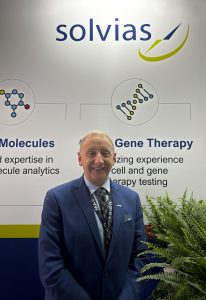 Solvias has been around for 25 years, originally founded in Switzerland focusing on small molecules. “Testing small molecules is still important, but now about 70% of our work is in large molecules and novel drugs like gene therapies. Essentially, if it’s injectable, we can handle the testing, release, and quality assurance.”
How does Solvias operate on a global scale?
“We’ve recently opened a large facility in the US, and that allows us to have conversations with clients from around the world. For example, Indian companies want to release products in Europe, so conferences like this are invaluable for connecting internationally. Although we don’t yet have a presence in Asia, the global footprint of our clients keeps things exciting.”
What trends have you noticed at industry conferences?
“It’s incredible how many new CDMOs and drug developers are popping up. Companies that previously focused on small molecules are now exploring large molecules, virus production, and vaccines. The diversity is growing, and it’s energising. It’s a reminder of how broad the industry is and how enthusiastic people are about innovation. You really feel the positivity and momentum when you walk around these events.”
How do you view the role of AI in drug development?
“I see AI as overwhelmingly positive,” said Danny. “Companies are using AI for drug discovery, which reduces randomness and guesswork. On the operational side, AI can help with administration, automation, and cost reduction — these have moved from being nice-to-have to essential tools.”
AI is also improving clinical trials. “Instead of randomly selecting participants, AI allows us to segment patients and target drugs more effectively. This means we can increase success rates — instead of 60% of patients benefiting, it could be 90–95%, even 99%. That also improves cost efficiency and ensures the right drug reaches the right patient.”
“Overall, I think AI will make drug development more successful. It won’t replace experts anytime soon, but it enhances our ability to deliver better outcomes, faster.”