Apoha raises $36M to expand molecular behaviour data platform
London-based technology company Apoha has emerged from stealth with $36 million in funding to expand its molecular behaviour analysis platform across pharmaceutical, food and materials applications.
The financing round was led by Singular, with participation from Draper Associates and existing investors Redalpine, Seedcamp, Wilbe and Nucleus. Apoha also received grant support from Innovate UK.
The company is developing what it calls Liquid State Intelligence, a data platform designed to measure how molecules, formulations and materials behave under real-world conditions. Apoha argues that this information represents a missing layer of data between molecular sequence and molecular structure that could improve decision-making in drug development and other industries.
The funding will support further development of the platform and expansion of commercial partnerships across life sciences, food technology, materials science and artificial intelligence applications.
Apoha’s technology is based on research conducted by founder and chief executive officer Shamit Shrivastava, who began investigating the behaviour of molecules at liquid interfaces in 2008. The company was founded in 2021 by Shrivastava and chief operating officer Anshika Srivastava and has since built a portfolio of more than 60 patents covering its hardware, software and data technologies.
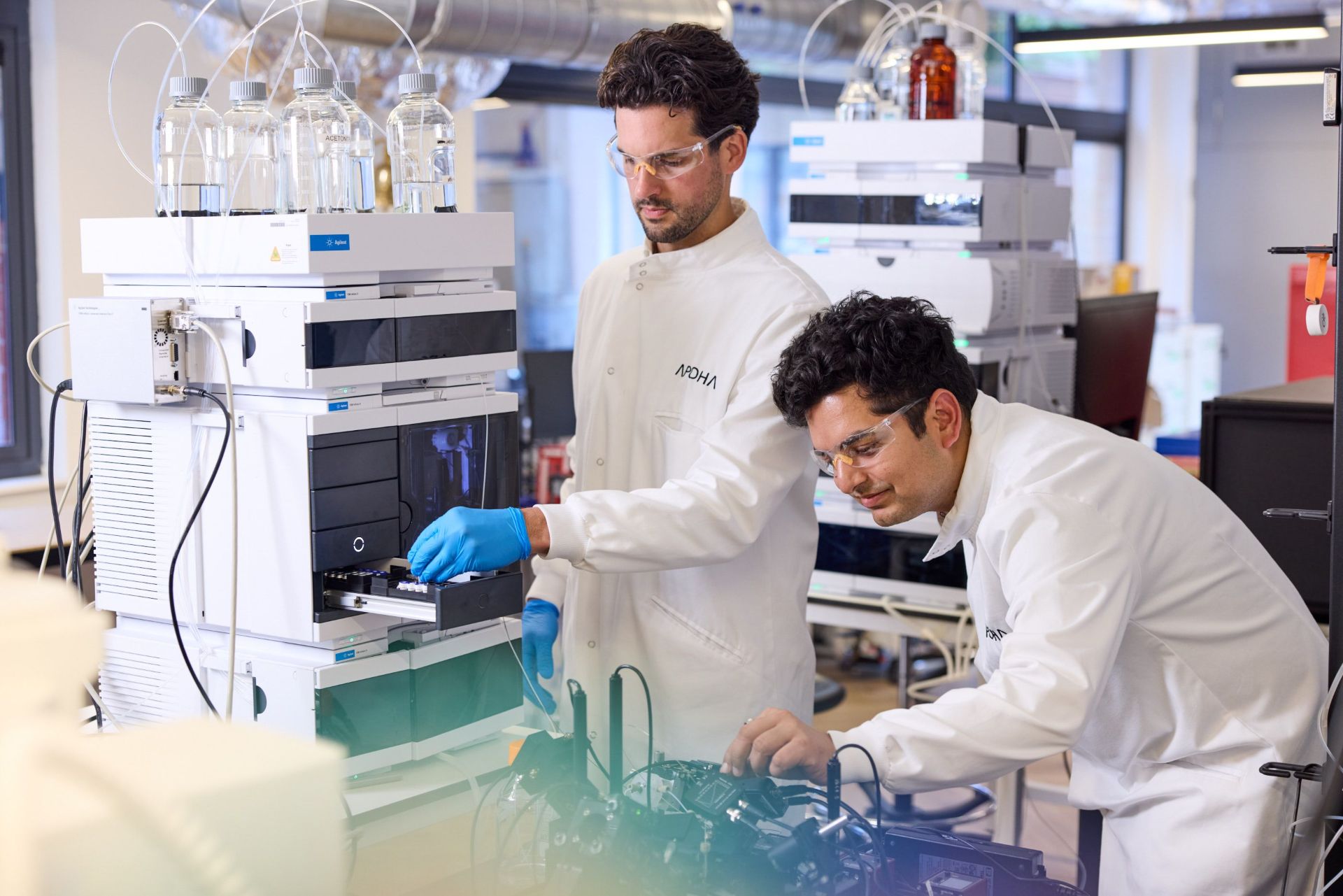
The company’s first commercial product, VIBE, short for Variations in Inter-facial Behaviour Under Excitation, generates measurements intended to capture how molecules and materials respond to different environmental stresses. According to Apoha, a single test produces more than 1,000 behavioural descriptors from a small sample suspended in liquid.
The platform is already being used by several commercial partners. Apoha said joint research with pharmaceutical company Boehringer Ingelheim demonstrated that the technology could identify high-risk antibody candidates with more than 90% precision using as little as eight micrograms of material.
The company also reported that its platform outperformed 12 commonly used industry tests in an analysis involving a dataset of 236 clinical-stage antibodies. The findings were published as part of ongoing efforts to validate the technology.
In addition to antibody development, Apoha is collaborating with biotechnology companies on applications including lipid nanoparticle development and predictive modelling of biological therapies.
Shamit Shrivastava said: “Liquid State Intelligence took 15 years of science and 5 years of company-building to bring to life. There is no shortcut to this data class — it cannot be scraped from the internet, synthesised, or retrofitted from existing assays. It has to be measured.”
He added: “Where sequence gave us the language of biology and structure the language of design, Liquid State Intelligence gives us the language of behaviour — what matter, molecules and materials actually do — and we are the company building it.”
The company believes molecular behaviour data could become increasingly important as artificial intelligence systems are applied to real-world scientific and industrial problems beyond language and image analysis.
Anshika Srivastava said: “Machines have learned to see what matter looks like and to read what we say about it. They have not learned to taste, smell or feel matter — to perceive how a drug dissolves, how a flavour holds, how a material wears. That is the layer we are building.”
The funding reflects continued investor interest in technologies designed to improve the efficiency of drug discovery and development, particularly platforms that generate novel biological or chemical datasets for use in machine learning and predictive modelling.
While Apoha’s commercial traction and scientific validation efforts are notable, many of the broader claims about transforming pharmaceutical development and enabling new forms of physical-world AI remain to be demonstrated through wider industry adoption and clinical outcomes.