
AI virtual screening tool boosts hit rate 100-fold on challenging drug targets
An AI-driven virtual screening platform developed by Deep Origin has achieved a reported 100-fold improvement in identifying potential drug candidates against a challenging therapeutic target, according to new preclinical research published on bioRxiv.
Researchers say the company’s DODock and DOScore platform combines machine learning with physics-based modelling to overcome one of the biggest limitations facing AI drug discovery: maintaining predictive accuracy when working with previously unseen biological targets.
Rather than relying solely on patterns learned from historical datasets, the system integrates molecular physics into the docking process, allowing it to predict how compounds interact with proteins while reducing the risk of false positives that have limited many previous virtual screening approaches.
AI model tackles longstanding virtual screening challenge
Virtual screening has been used in drug discovery for decades to narrow billions of potential compounds down to a manageable number for laboratory testing. However, conventional computational approaches often struggle when faced with novel proteins or unfamiliar chemistry.
Deep Origin argues that many existing AI models perform well only because similar molecules or protein structures have inadvertently appeared in their training datasets. Once confronted with genuinely new biological targets, prediction accuracy falls sharply.
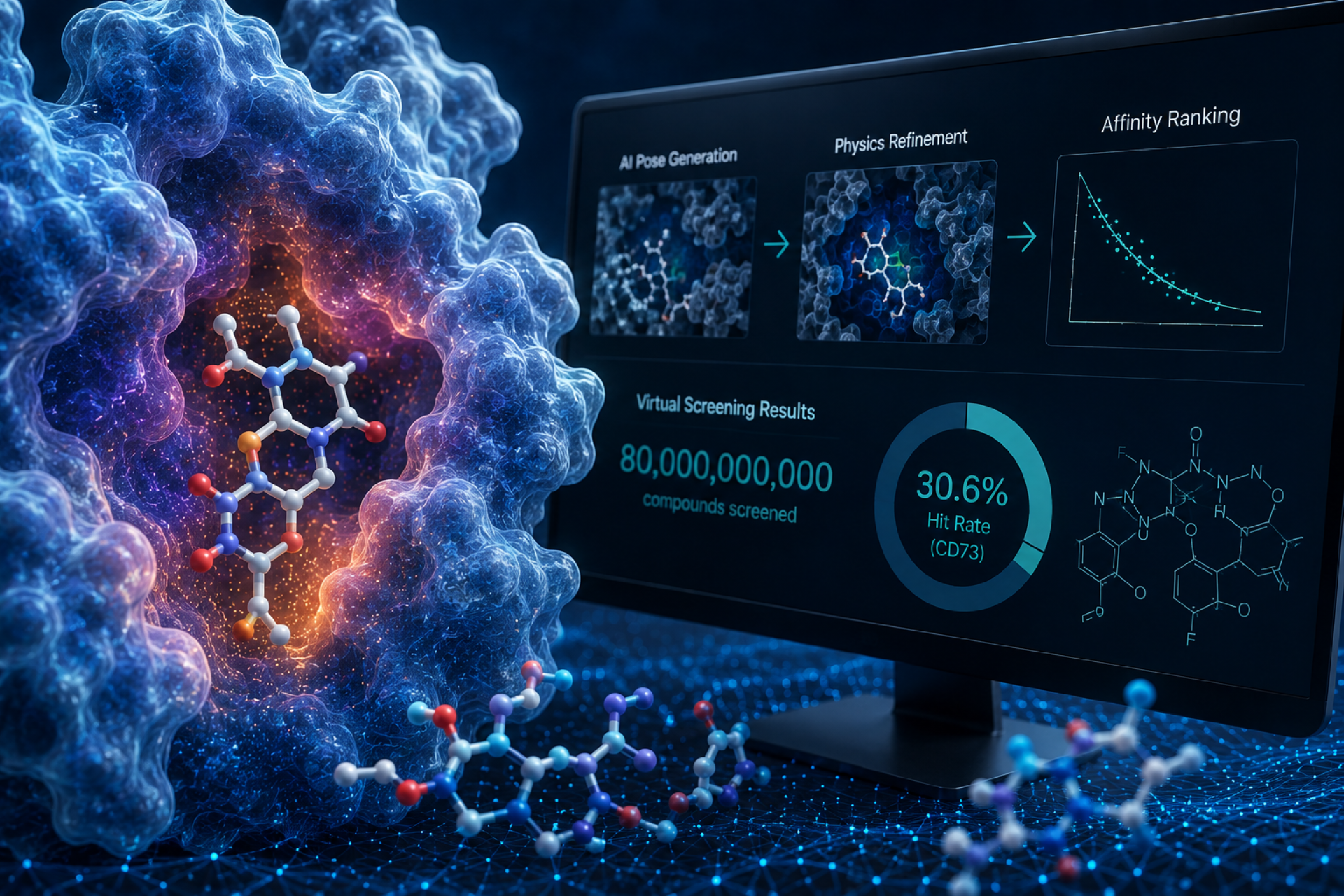
To address this, the company developed DODock, which first generates potential binding poses using diffusion-based AI before refining them with a physics engine that calculates molecular interactions. A second model, DOScore, then ranks compounds according to their predicted binding affinity.
According to the preprint, the approach maintained high prediction accuracy across multiple independent benchmark datasets, outperforming several widely used computational docking methods.
Wet-lab validation produces promising results
The researchers also tested the platform prospectively by screening an 80-billion compound virtual library before validating predictions experimentally.
The strongest performance came against CD73, an increasingly important immuno-oncology target, where the platform identified active compounds in approximately 30% of molecules tested.
Deep Origin said this represented around a 100-fold improvement over a previously published machine learning screen against the same target.
The platform also identified novel compounds against IRAK4, Factor XIa and IL-17A, covering a range of increasingly difficult biological targets, including protein-protein interaction sites that have traditionally been difficult for computational screening.
Across all four programmes, the researchers reported that identified compounds showed substantial chemical novelty rather than representing small variations of previously known molecules.
Blind prediction validated months later
One of the study’s more notable findings involved a fully blind prediction of how AstraZeneca’s oral PCSK9 inhibitor binds to its target.
Deep Origin predicted the binding pose months before an experimental crystal structure became publicly available. According to the company, subsequent structural analysis confirmed the prediction to within approximately 1.2 angstroms.
The findings suggest that integrating machine learning with molecular physics may improve the reliability of AI-guided drug discovery, particularly for targets where little structural information exists.
Garegin Papoian, co-founder and chief scientific officer of Deep Origin, said: “Virtual screening has been widely used for more than 40 years, yet it has rarely delivered an actual drug. The field learned to live with a low accuracy ceiling. We set out to change that by pairing physics with machine learning, ensuring our method holds its accuracy on novel targets where training data alone runs out.”
Michael Antonov, co-founder and chief executive officer, added: “What matters is how a screen behaves on a target no one has solved yet, so that is where we tested our model with strict splits and cases built to make it fail. How our model performs on those rigorous tests, not on inflated benchmarks, is what dictates how many molecules brought to the bench are likely to be real.”
The work has been published as a preprint on bioRxiv and has not yet undergone peer review.