
Robots could slash cost of cell therapy by 74%, opening doors to wider access
Multiply Labs and Universal Robots pioneer automated manufacturing for personalised cancer treatments, making bespoke therapies more affordable.
Cell and gene therapies have transformed the treatment landscape for cancers such as lymphoma and leukaemia — but at a staggering cost. With prices ranging from $300,000 to $2 million per dose, these life-saving personalised medicines remain out of reach for most patients.
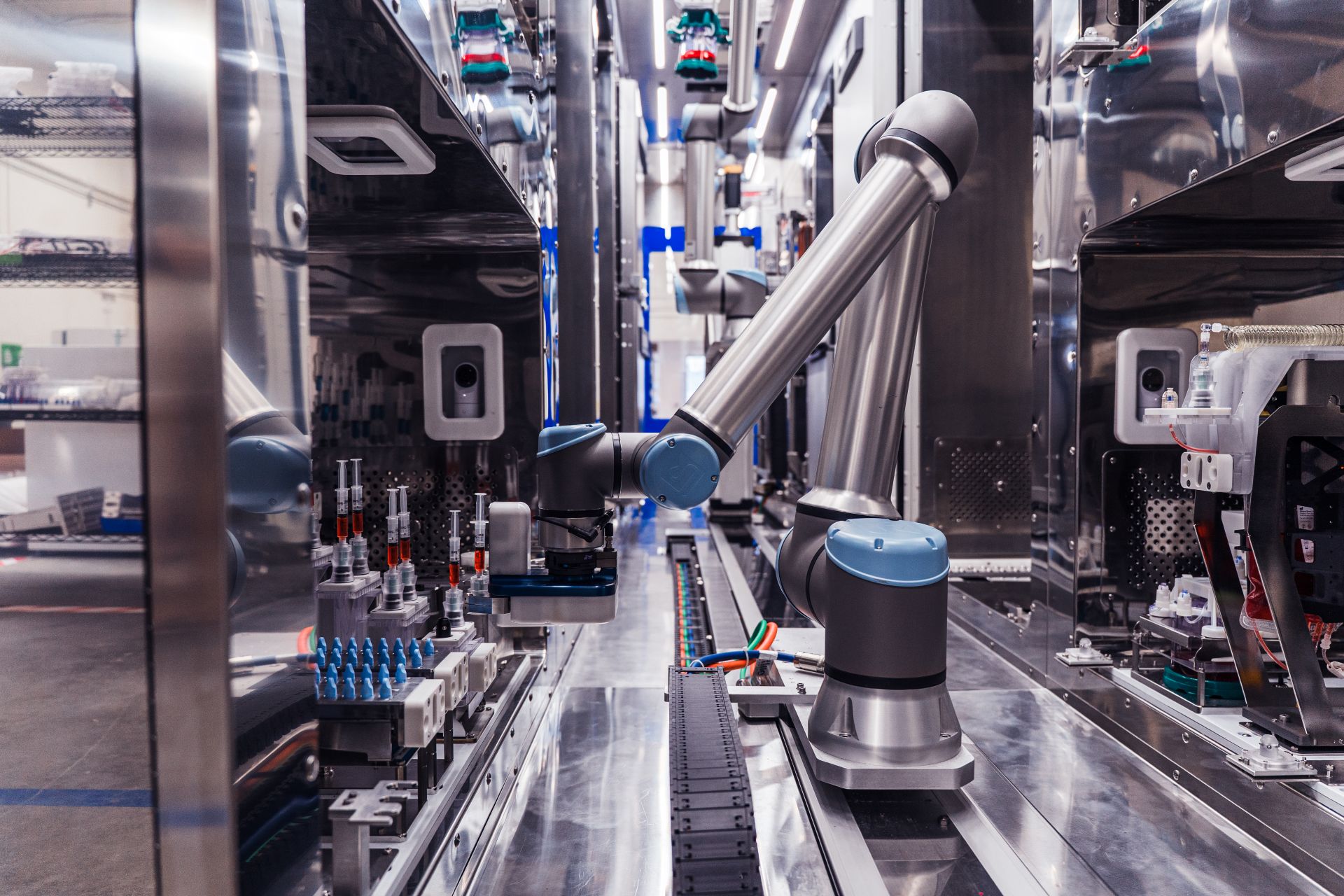
Now, Multiply Labs, a San Francisco-based robotics company, claims it can change that equation. In collaboration with Universal Robots (UR) and scientists from UCSF, the company has unveiled a robotic biomanufacturing cluster that delivers a 74% cost reduction in cell therapy production, while increasing sterility, efficiency and space utilisation.
From “artisanal” to automated
“Historically, cell and gene therapy manufacturing has been manual, almost artisanal,” says Multiply Labs CEO Fred Parietti. Scientists perform hundreds of delicate tasks by hand — pipetting, shaking, and cultivating cells. The bespoke nature of therapies, tailored from each patient’s own cells, makes mass production impossible and increases the risk of costly failures if contamination occurs.
Multiply Labs’ robotic system replaces those manual processes with modular clusters of UR robotic arms, stacked floor-to-ceiling and working in parallel. These cobots mimic human handling with enhanced repeatability and sterility. “Robots don’t breathe, and they don’t touch stuff they’re not supposed to,” Parietti adds.
Quantum leap in efficiency
In trials led by Dr Jonathan Esensten (formerly UCSF, now Sheba Medical Center), robotic manufacturing matched traditional methods step-for-step — but at a fraction of the cost. “When we compared manual to robotic processes, we found a cost reduction of approximately 74%,” Esensten explains. “And crucially, while human handling led to contamination in one case, no contamination was seen with the robotic system.”
The system also delivers up to 100 times more patient doses per square foot of cleanroom space compared with manual methods, a critical factor in scaling global access.
Learning from the experts
Central to the breakthrough is Multiply Labs’ imitation learning technology. Robots are trained on video recordings of expert scientists performing key tasks, then replicate those processes autonomously, 24/7, with high fidelity.
This not only ensures regulatory compliance — “companies can document that it’s the exact same process, just robotically performed,” notes Esensten — but also avoids the need for costly re-approval of novel methods.
Partnership with Universal Robots
After evaluating multiple platforms, Multiply Labs selected Universal Robots for their six-axis precision, force sensitivity, cleanroom compatibility, and strong software integration.
UR president Jean-Pierre Hathout said: “By empowering Multiply Labs to replicate intricate manual processes with high precision and scale, our cobots are redefining efficiency in pharmaceutical manufacturing. More importantly, it’s broadening access to life-saving treatments.”
Global rollout
Multiply Labs’ robotic clusters are already deployed with pharmaceutical partners worldwide, with validation studies also underway at Stanford University.
“This will really change how we think about manufacturing bespoke therapies,” says Parietti. “By lowering costs and enabling distributed production, we can make cell and gene therapies accessible to patients globally.”